
Lakeville Wood Flooring installs basement flooring across Lakeville, MN and has done for more than 20 years, serving surrounding cities including Farmington, Apple Valley, Burnsville, Savage and Elko New Market. Finished lower levels, walkouts, lookouts and full basements all fall under it, and almost all of the difficulty in the job sits in the slab rather than in the flooring.
So that is where we start. The quote for a lower level comes from a moisture reading taken on that lower-level slab itself, never inferred from the floor above it, and the number goes in writing. A slab that reads high does not rule out a wood floor; it rules out certain adhesives, certain underlayments and certain products, and knowing which before you choose is the difference between a floor and a warranty claim.
Grade is the other thing established before anything is specified. The installation guidelines define it by the soil outside rather than by whether the room has a door to the yard, and soil sitting within three inches of a floor puts that level below grade. A walkout with a patio door on one wall and several feet of dirt against the others is quoted as what it is.
Reading the Slab Before Anything Is Specified
In-Situ Relative Humidity Testing
Moisture in concrete is measured by drilling probes into the slab and reading the relative humidity inside it, which is what ASTM F2170 describes. A surface test tells you about the surface; a slab that reads acceptably at the top can still be driving moisture upward from below. We take the in-situ reading at multiple points, because slabs are rarely uniform, and the numbers land on the quote.
Radon-Resistant Construction and Sub-Slab Assemblies
New Minnesota homes have been built radon-resistant since 2009: clean aggregate under the slab, a soil-gas retarder of polyethylene sheeting, sealed joints and penetrations, and a vent pipe run through the roof. The Minnesota Department of Health notes the same measures can reduce water vapor coming through the slab. Whether that assembly exists, and whether the system is passive, changes how we read a borderline number.
Perm Ratings and What Goes Between
What separates the slab from the floor is chosen from the reading rather than out of habit. A vapor retarder with a rated perm value, a moisture-control adhesive, or a cork underlayment under a floating floor each handle a different moisture drive. Putting a low-perm layer in the wrong place traps water in the assembly, so the specification follows the meter instead of a product catalog.
Choosing the Floor for a Lower Level
Engineered Flooring Below the Soil Line
Engineered flooring is real wood over a cross-laid core, and that construction is precisely why it holds dimension where solid strip flooring cannot. Below grade it is the correct specification rather than a compromise, and the wear layer still allows future sanding provided it is thick enough. We name the construction and the wear layer thickness on the quote so you know what you are buying.
Wood, Luxury Vinyl Plank and Carpet Compared Honestly
Wood holds value and looks like the rest of the house; luxury vinyl plank survives a sump failure that would buckle wood and costs less; carpet is the warmest underfoot and the worst outcome in standing water. We give the comparison straight rather than steering it toward the product with the better margin, because the right answer depends on whether this room has taken water before.
Installation Method Over Concrete
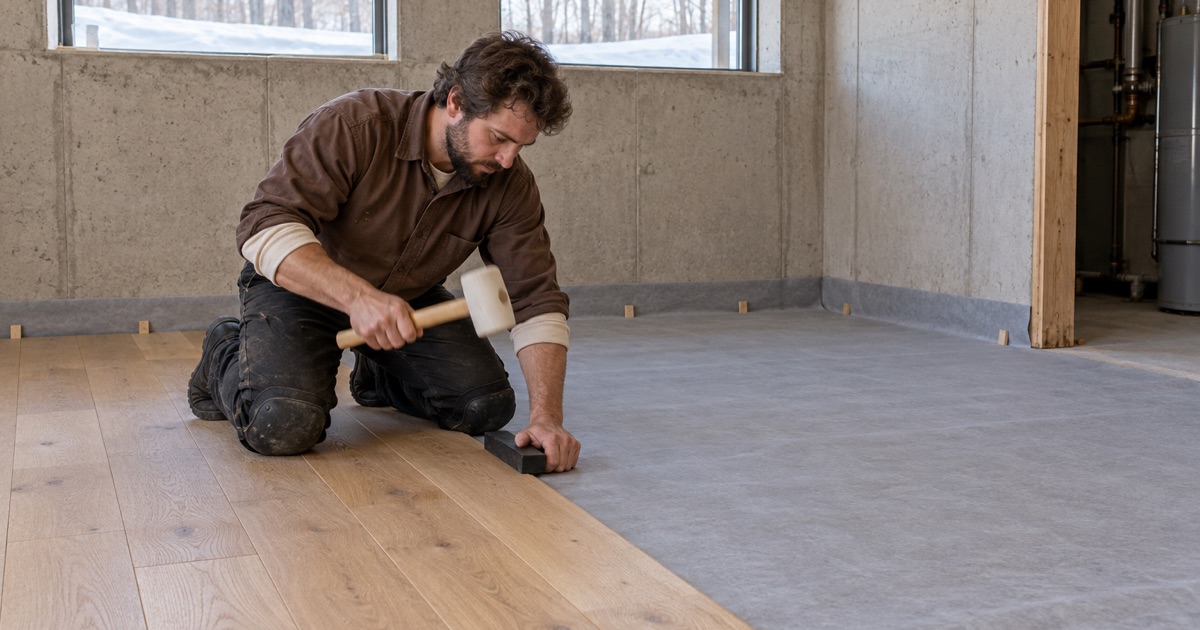
Over a slab the practical methods are a floating floor on underlayment, a full-spread glue-down with a moisture-control adhesive, or a nail-down over sleepers or plywood that raises the finished height. Each tolerates a different slab reading and each sounds different underfoot. We match the method to the measured number and tell you what ceiling height the raised options will cost you.
Living With a Lower-Level Floor
Sump Failures, Window Wells and Recovery
Most lower-level water arrives from a sump pump that quit or a window well that filled faster than it drained. An engineered floor caught early and dried fast frequently survives; one left wet delaminates as the plies separate, and that is not repairable. We tell you which failure modes your chosen floor has, so the decision includes the bad day as well as the good one.
Humidity Downstairs Is Not Humidity Upstairs
A lower level usually runs cooler and damper than the main floor through summer and drier through the heating season, so the floor down there lives in a different band from the one above it. We record both when we measure, and where a dehumidifier is what keeps the floor inside its specification we say so at the quote rather than after the first season.
Matching the Main Level Without Chasing It
An exact match between a solid upstairs floor and an engineered lower-level floor is rarely achievable, because the species, the mill and the finish system all differ. The workable answer is deliberate coordination — the same species and a close sheen, with the stairs used as the break — and samples approved in your own light before anything is ordered.
- 20+ Years in the Trade
- Free Written Estimates
- Moisture Readings on Every Quote