
Lakeville Wood Flooring recoats hardwood floors across Lakeville, MN and has worked on wood floors here for more than 20 years, serving surrounding cities including Farmington, Apple Valley, Burnsville, Savage and Elko New Market. A screen-and-recoat — a buff and coat, in the trade’s other name for it — abrades the finish already on your floor and adds a fresh coat over the top, restoring sheen and buying years of service without the wood ever being sanded.
It is the best value available in this trade and it has one hard limit: there has to be finish everywhere for the new coat to bond to. Bare wood anywhere on the field disqualifies a recoat, because the coating will not adhere across that boundary and will eventually peel back from it in sheets. That is not a judgment call made from the doorway, so we settle it with a test patch on your own floor and show you the spot that decided it.
The floors that benefit most are the ones nobody has neglected. A floor recoated while its finish is still intact may never need a full sanding, because each coat protects the wood beneath it. A floor left until the lanes are bare has lost that option and is now a sanding job, which is why timing matters more here than on any other service we offer.
Deciding Whether a Recoat Will Hold
The Test Patch in the Traffic Lane
We abrade and coat a patch where the floor is most worn — the lane in from the garage door, the pivot in front of the sink — rather than in a corner that will pass regardless. That is the area that decides the answer for the whole room. You see the patch before anything is committed, and where it will not take, the recommendation changes in front of you rather than in an email afterward.
Contaminants That Stop a Coat From Bonding
Bare wood is not the only disqualifier. Floors that have been maintained with an oil soap or an acrylic polish carry residue that causes fisheye, orange peel or a hazy blush in a new coat, and those products are extremely common in houses that have had the same cleaning routine for decades. We look for the signs and test for them, because a contaminated floor that is coated anyway fails visibly and fails everywhere at once.
What the Existing Finish Actually Is
A waterborne coat over an oil-modified floor, or any coat over a hardwax oil floor, is a compatibility question rather than a preference. Hardwax oil floors are maintained with more oil rather than recoated with polyurethane, and getting that wrong produces a finish that never properly cures. Identifying the existing system is part of the assessment, not an assumption based on how the floor looks.
How a Recoat Is Actually Done
Screening the Floor
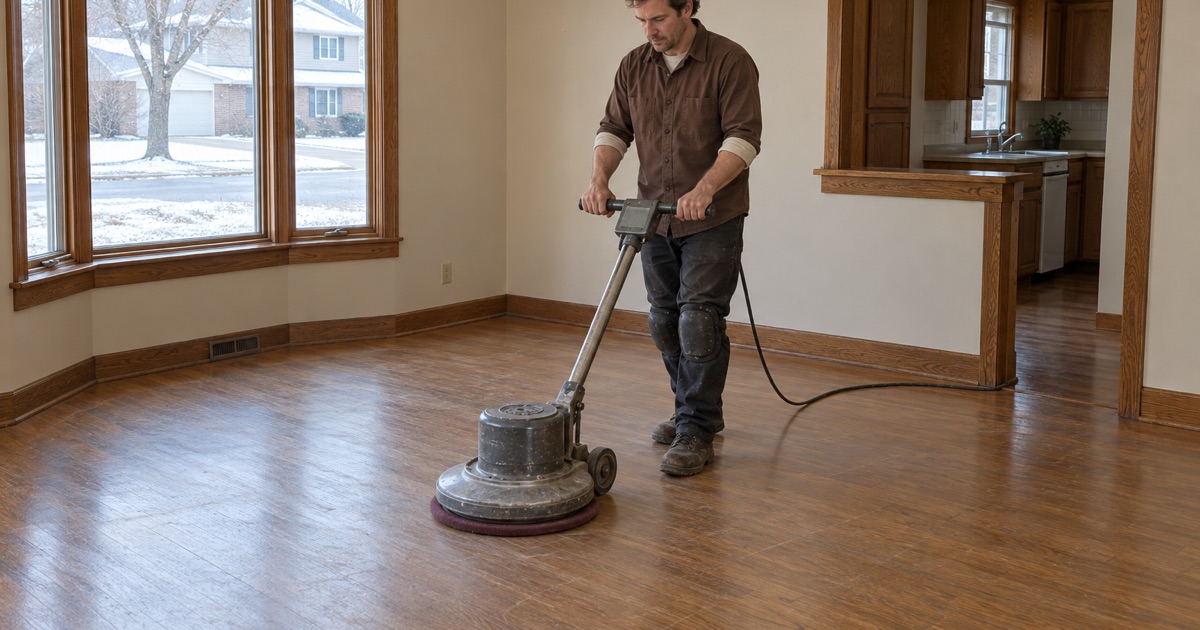
A buffer fitted with an abrasive screen cuts the gloss off the existing finish so the new coat has a mechanical key to grip, and the corners and edges are done by hand where the machine cannot reach. Skipping the perimeter is the most common shortcut on a cheap recoat and shows up as a peeling border a year later. The screening grit is named on the proposal.
Cleaning Before Coating
Between screening and coating, the floor is vacuumed with a HEPA vacuum and tacked, because a single missed particle becomes a permanent bump under the finish. This is unglamorous and it is most of what separates a good recoat from an average one. In a house that cannot open its windows for half the year, containment during screening also keeps that dust out of the rest of the rooms.
The Coat Itself, and the Cure
One coat is standard and two is worth discussing on a floor with heavy traffic ahead of it. Waterborne polyurethane is the usual choice for its speed and its clarity, and a two-component waterborne system where durability is the priority. The sheen is chosen at the quote, sampled in the room, and named on the finish schedule along with the number of coats.
Timing, Cost and Keeping a Floor on the Cycle
Recoating as Maintenance Rather Than Rescue
The cheapest floor to own is one that is recoated before it needs to be. Each coat takes the wear instead of the wood, so a floor kept on a recoat cycle can go decades without a sanding while a neglected floor of the same age has already used one of its sandings. We will tell you at a refinish what the recoat interval for your household is likely to be.
What a Recoat Cannot Fix
Color changes need bare wood. Deep scratches, pet damage, cupping, crowning and gray water staining all need sanding. Boards that need replacing need replacing. We are direct about this because a recoat sold over the top of any of them looks better for a month and then reports the same problems through a new coat, at which point the money is gone.
Dust, Downtime and Getting the Room Back
Screening generates fine dust rather than the volume a full sanding makes, and the job is usually a single day plus cure. Furniture is out for the coating and comes back on the schedule the quote names — walkable first, furniture next, rugs last, because a rug laid on an uncured coat marks it permanently. Those return-to-service times are handed over in writing rather than estimated on the way out.
- 20+ Years in the Trade
- Free Written Estimates
- Moisture Readings on Every Quote